Through Resolution No. 5, Minute No. 25 dated June 19, 2025, the Central Bank of Paraguay (“BCP”) approved the extension of the Regulation establishing Minimum Standards for Good Corporate Governance (the “Regulation”), expanding its application to entities supervised by the Superintendency of Securities.
Through Resolution No. 5, Minute No. 25 dated June 19, 2025, the Central Bank of Paraguay (“BCP”) approved the extension of the Regulation establishing Minimum Standards for Good Corporate Governance (the “Regulation”), expanding its application to entities supervised by the Superintendency of Securities.
The Regulation sets out specific guidelines in the following areas:
Board Responsibilities: The board is responsible for the entity’s strategy, risk management, organizational culture, and the overall oversight of corporate governance. It must ensure an adequate organizational structure and promote ethical conduct at all levels.
Control Culture and Ethical Conduct: Entities are required to implement clear policies for the prevention of conflicts of interest, adopt codes of ethics, and establish mechanisms for resolving internal conflicts.
Strategic Objectives and Corporate Values: Entities must have a strategic framework approved by the board, aligned with their risk appetite, and ensure its communication and enforcement throughout the organization.
Information Technology (“IT”): Entities must establish adequate policies and structures for IT management, with a particular focus on security, regulatory compliance, and support for strategic decision-making.
As a result of this extension, Title 27 of the General Regulation of the Securities Market, which previously regulated this matter only partially for securities market entities, has been repealed. The previous framework is now replaced by a consolidated and unified version, applicable to all entities supervised by the BCP’s Superintendencies.
On June 27, 2025, Law No. 7503/2025 "On the National Payment System" was enacted, fully replacing the former Law No. 4595/2012. This new legislation marks a significant shift in the regulatory framework for payment systems in Paraguay, significantly expanding the supervisory scope of the Central Bank of Paraguay (BCP).
Unlike the previous framework, Law 7503/25 include as potentially regulated entities those that were previously outside the BCP’s direct supervision, such as:
Payment gateways
Payment processors
Electronic money issuers
Payment service providers (PSPs)
Other actors in the payments ecosystem
The BCP is currently drafting specific regulations for Payment Initiation Service Providers (PISPs), with the aim of formally incorporating financial technology entities (fintechs) as authorized players in the ecosystem. This process also includes updating the requirements and operational rules that govern such services.
Key highlights of Law 7503/25:
Establishes a comprehensive legal framework for the organization, supervision, and operation of the National Payment System.2. Introduces guiding principles such as security, interoperability, financial inclusion, and transparency.3. Grants the BCP powers to regulate, register, supervise, and sanction participants.4. Extends the scope to include non-traditional financial entities offering payment-related services.
What does this mean?
Although the law has not yet been specifically regulated, its broad drafting allows the BCP to determine through resolutions who will be subject to it. Reports already indicate that the BCP is requesting information and compliance from companies previously outside formal oversight.
Who may be affected?
Technology companies, fintechs, e-commerce platforms with proprietary payment gateways, e-money issuers, and other entities involved in the payments cycle may be affected by this new legislation.
Registration and authorization
Technical and security requirements
Transparency and access rules
Reporting obligations
At Vouga Abogados, we closely monitor regulatory developments in the sector and offer our legal team’s assistance to:
Provide updated information on the implementation of the new law.
Conduct preventive legal assessments on the applicability of the regulation.
Assist in preparing compliance strategies in response to potential BCP requirements.
For further information or to schedule a meeting, please do not hesitate to contact us.
La Dirección Nacional de Propiedad Intelectual (DINAPI) avanza en la modernización del marco legal aplicable al diseño industrial en Paraguay. Actualmente, la materia se rige por la Ley N° 868/81 “De Dibujos y Modelos Industriales”, pero se encuentra en elaboración un nuevo proyecto de ley que busca actualizar y adecuar esta normativa a los desafíos actuales del entorno creativo y tecnológico.
Este trabajo se realiza junto con la Oficina de Propiedad Intelectual de la Unión Europea (EUIPO), en el marco del programa AL INVEST Verde DPI, con el apoyo técnico del consultor internacional Laurent Manderieux.
Entre las propuestas destacadas del borrador se incluyen:
El cambio de denominación a “Diseños Industriales”.
La inclusión de animaciones como posibles objetos de protección.
Nuevas disposiciones alineadas con estándares internacionales.
El anteproyecto ya fue presentado en jornadas de trabajo con representantes de DINAPI, del ámbito académico y de los gremios de agentes de propiedad intelectual. Próximamente se habilitará un espacio virtual para recibir comentarios y sugerencias de todos los interesados. Por ejemplo, el tema de las tasas aún no ha sido abordado, ya que se encuentra en proceso de revisión interna. Los plazos y detalles de la consulta pública serán anunciados oficialmente por DINAPI.
Esta iniciativa representa un paso clave hacia una normativa más moderna, que fortalezca la protección de las creaciones y acompañe el desarrollo del sector productivo nacional.
2025 Budgetary limits for the National Directorate of Tax Revenues ("DNIT") to credit amounts for undue or excess payments, interest and surcharges.
Decree No. 3165
December 23, 2024
Real estate tax values for the taxable base of the real estate tax and its additions, corresponding to fiscal year 2025.
Law No. 6380
September 25, 2019 (Update)
Validity of the limit for withholdings on account of Value Added Tax ("VAT") for local suppliers.
January 2025
Norm
Date
Content
Decree No. 3237
January 16, 2025
Relaxation of the requirements for importers under the Buying Tourism Regime ("RTC").
Decree No. 3108
December 19, 2019 (Update)
Percentage of guarantees to be submitted for the accelerated VAT refund regime by 2025.
General Resolution DNIT N° 01
January 12, 2024 (Reminder).
Legal entities that register as new taxpayers in the Single Taxpayer Registry ("RUC") must issue their vouchers only electronically.
February 2025
Rule
Date
Content
Decree No. 3339
February 10, 2025
Incorporation to the Paraguayan legal system of the extension to the limit of changes in the lists of national exceptions to the Common External Tariff ("CET") of the Southern Common Market ("Mercosur").
Decree No. 3379
February 21, 2025
Incorporation into the Paraguayan legal system of the amendments to the Mercosur Common Nomenclature ("NCM") and its corresponding CET.
DECEMBER - 2024:
► Law No. 7408/2024 - The 2025 budget limits are established for the DNIT to credit amounts for undue or excess payments, interest and surcharges.
Law No. 7408/2024 approved the General Budget of the Nation ("PGN") for fiscal year 2025 and, with it, established several tax measures that, to a greater or lesser extent, affect taxpayers. One of these measures (Articles 235 and 236 of the PGN) are the annual budgetary limits for crediting taxpayers for balances due to:
for undue or excess payment,
VAT refunds purchased from non-profit entities ("ESFL"), and for accessories in the following recovery processes
for accessories in the following tax credit recovery processes:
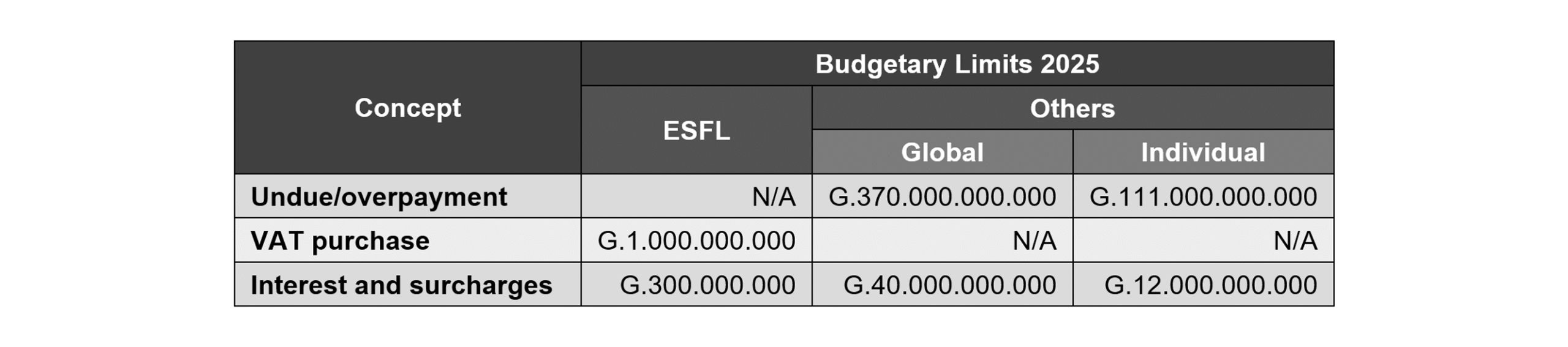
This is a budgetary measure that has been implemented every year since Law No. 5061/2013 (see Article 7) and Decree No. 850/2013. For this fiscal year 2025 the overall and individual (per taxpayer) budget limits are the same as for fiscal years 2023 and 2024, being the following:
The global limits represent the maximum amount that DNIT can credit in the indicated concepts during the whole fiscal year 2025, while the individual limits per taxpayer are 30% of the global limit for each concept. This means that no taxpayer may represent a higher percentage of credits than indicated, thus avoiding that only one taxpayer excludes the others.
These budgetary limits do not apply to VAT refunds purchased from NPOs as a result of court rulings, as these have their own limits. Furthermore, the way in which this concept is credited to NPOs also differs from the normal regime, since these amounts are paid in cash, and not with credit to the taxpayer's current tax account, as occurs in the other cases.
In the event that the budgetary limits are reached during the fiscal year, the amounts pending crediting are deferred to the following fiscal year without generating legal accessories (interest, etc.). The area responsible for making the credits must correlatively record the resolutions that provide for them, for their inclusion in the PGN of the following fiscal year.
► Law No. 6,380/2019 - Seeks to extend the validity of the limit for VAT withholdings on account for local suppliers (UPDATE).
Law No. 6380/2019 ("Tax Law") introduced several short and medium term novelties to the national tax regime. One of them was the limit for VAT withholdings on account, provided for in the first paragraph of its Article 136. This limit was set at 10% of the tax stated in the sales receipt.
The Tax Law provided for the application of such limit as from the fourth year of its effectiveness, and due to the fact that the Tax Law became effective on January 1, 2020, the date for the implementation of the withholding limit was set for January 1, 2023. In other words, the application of this withholding limit was deferred from 2020 to 2023.
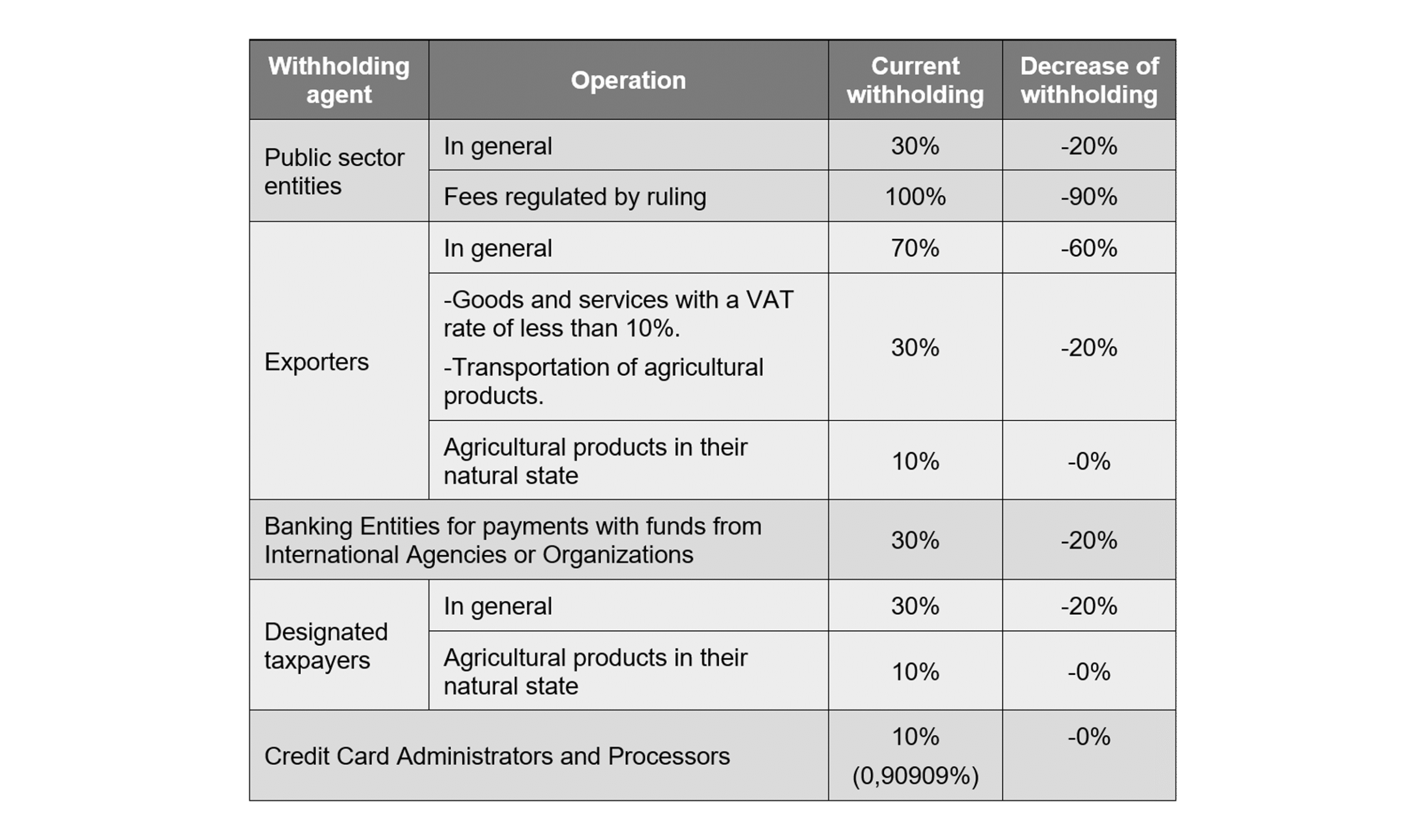
This decrease in the withholding percentage has great consequences for taxpayers that are VAT withholding agents, since they must adjust their systems to the new limit. Among such taxpayers are the following:
In addition to the withholding limit, the second paragraph of article 136 of the Tax Law provided for the progressive reduction of the percentage of VAT withholding on account as from the year following the effective date of the Tax Law and until the deadline for applying the withholding limit is met, i.e., from 2021 to 2022.
However, this progressive reduction was conditioned to the issuance of a decree of the Executive Power providing the schedule for such purpose, but since this did not happen, the withholding limit should have been in force all at once, without any progressive adjustment. Moreover, in Article 275 of Law No. 6873/2022, Article 287 of Law No. 7050/2023 and Article 285 of Law No. 7228/2023, which approved the PGN 2022, 2023 and 2024, respectively, the decrease was suspended for those years; which, curiously, was replicated again for this 2025 with Article 261 of Law No. 7282/2023, which approves the PGN for that fiscal year.
The inclusion of this suspension in the laws of the PGN 2023 to 2025 appears as an error that may generate confusion among individuals, since it refers to a rule that is no longer in force for those years, because the progressive decrease was a transitory provision that could only be implemented from 2021 to 2022, but no longer from 2023, since from then on it no longer makes sense, because the withholding limit is applied.
It would be appropriate for the DNIT to come out on top of this and issue ex officio a resolution clarifying the confusion that could be generated due to the referred suspension, even more so when this situation has been occurring since 2023, with the market operating as if the limitation of withholdings were not in force.
► Decree No. 3165/2024 - Whereby the real estate tax values are set for the taxable base of the real estate tax and its additions, corresponding to fiscal year 2025.
By means of Decree No. 3165/2024, the Executive Branch fixed the real estate tax values established by the General Directorate of the National Cadastre Service ("DGSNC") of the Ministry of Economy and Finance, which will serve as the taxable base for the determination of the real estate tax and its additions for the fiscal year 2025.
The adjustment made implies an increase of 3.6% in real estate values, both for urban and rural properties, based on the inter-annual variation of the CPI at the end of October 2024, as reported by the Central Bank of Paraguay.
It is important to remember that the amount of the tax is determined by applying the corresponding rates (normally 1%) to the tax valuation of the properties established by the DGSNC (tax base), which is made up as follows:
Urban real estate: land value (m2 of the real estate per G/m2) plus built value (m2 of the buildings per G/m2). The G/m2 is determined by the type of pavement with the highest value of the adjoining streets (fronts) of the property for the land value, and by the construction category for the buildings.
Rural properties: Land value (hectare ("ha") of the property per G/ha). The tax valuation of each district is determined according to its opportunity cost (distances to urban centers and accessibility) and the predominant type of soil, according to the categories indicated in the decree.
It also provides, among other things, for the valuation of properties that change from urban to rural category and vice versa, the procedure for the 50% exemption from tax on rural properties with forestry priority or with real rights to forest land, and the discount for rural properties with unproductive areas that differ from the type of soil in their district.
The amount of tax payable to the municipality can be consulted on the DGSNC website, in the municipalities section, property tax settlement section, by selecting the department of residence, the district, and the cadastral nomenclature of the property (register or current account).
JANUARY - 2025:
► Decree No. 3,237/2025 - Requirements for importers under the RTC are relaxed.
The RTC was established by Decree No. 2063/2024, providing for the intervention of 4 subjects, of which 2 would be taxpayers registered before the DNIT that would operate commercially under such regime. These taxpayers were classified, according to their function, as (1) traders and (2) importers ("RTC Importers"), the specific requirements for the latter being stricter, which were revised and made more flexible in Decree No. 3237/2025 ("RTC-2 Decree").
Originally, RTC Importers could not operate as such if they had not been in the commercial circuit for at least 2 years; however, Decree RTC-2 changed this, allowing companies with less than 2 years to operate by presenting a bank guarantee of USD 25,000 or its equivalent in guaranies, valid for at least one year from the date of the application, to cover their possible liability for tax or customs infractions.
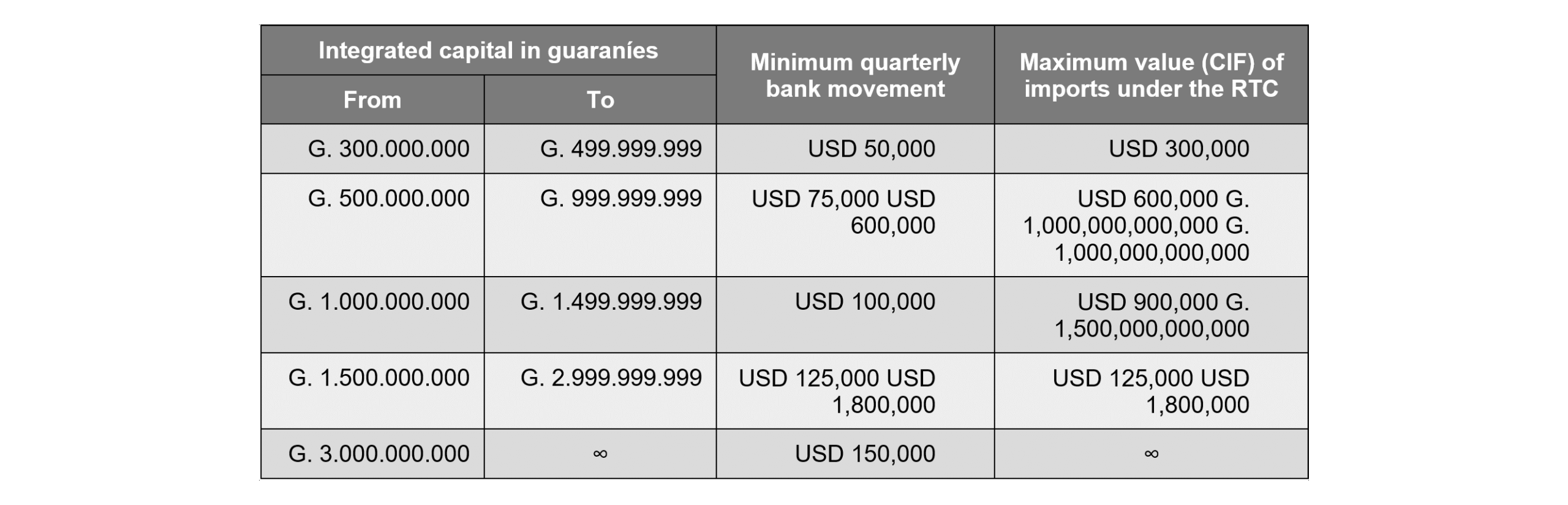
Another change introduced by Decree RTC-2 with respect to the requirements for RTC Importers consists in the reduction of the minimum integrated capital required of them, since it was originally G. 6,000,000,000 and now it has been reduced to G. 300,000,000, but with limitations up to G. 3,000,000,000,000 of integrated capital. This is because the reduction of the minimum integrated capital was linked to the reduction of the minimum banking movement in the last quarter -which was originally USD 200,000-, and to the establishment of a limit of imports according to the integrated capital, as follows:
In addition to the above, Decree RTC-2 extended the validity of the habilitations under the previous tourism regime of Decree No. 1931/2019, which would now expire on a future date to be set by the DNIT, instead of as of the effectiveness of Decree No. 2063/2024 in July of that year, as originally foreseen.
Another innovation of Decree RTC-2 consists in providing that the DNIT will prepare a risk profile of the RTC taxpayer, including that of its related persons (representatives, main shareholders or partners), which will be taken into account during the processes of continuous monitoring of the importers' compliance with their obligations.
Finally, Decree RTC-2 provided that the DNIT will proceed to suspend the status of beneficiary of the RTC of those taxpayers with respect to which any of the following situations are detected during a control or verification process:
The beneficiary of the RTC or his legal representatives are not located at the domicile declared in the RTC registry.
The importer or his legal representatives do not attend the summons made by the DNIT without a duly justified cause.
The importer or its legal representatives ignore one or more requirements made by the DNIT.
The suspension to operate under the RTC will be lifted once the situation or situations that gave rise to this measure are remedied in the manner and conditions to be determined by the DNIT.
If you wish to learn more about the RTC and Decree No. 2063/2024 that established it, we invite you to read the article published about it on this website by clicking here . ► Decree No. 3.108/2019 - The percentage of guarantees to be submitted for the accelerated VAT refund regime is set for 2025 (UPDATE). Article 102 of the Tax Law provided that exporters and freight forwarders may request the accelerated refund of the VAT credit affected to their export or export freight operations, presenting for this purpose a bank guarantee, financial guarantee or insurance policy with a minimum validity of 90 business days from the date on which the refund request is filed.
For the first 3 refund requests under the accelerated regime, the guarantee must cover 100% of the capital of the VAT credit required to the DNIT, plus accessories. From the fourth application onwards, the guarantee must only cover the portion of the VAT credit resulting from the average percentage of rejected credits ("PCR") under the accelerated regime in the months from January to November of the previous year, plus accessories.
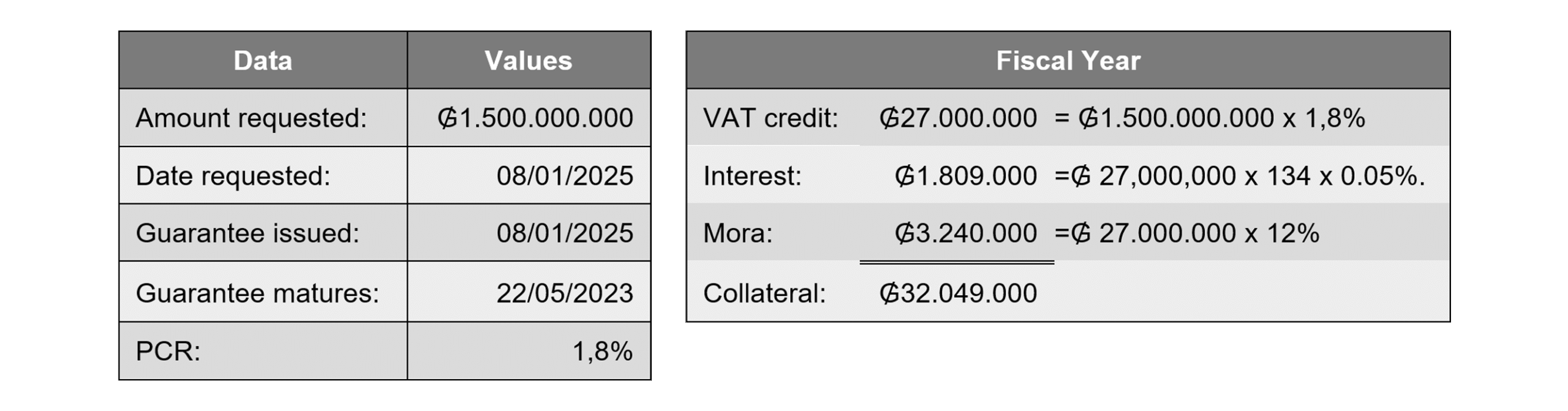
To establish the value of the guarantee, the applicant must multiply the PCR by the VAT credit for which a refund is requested. The following legal accessories must be added to the resulting amount, calculated until the expiration date of the guarantee on the amount of the VAT credit resulting from the PCR: daily interest of 0.05% and late payment penalty of 12%.
The DNIT publishes the PCR annually, and on this occasion the PCR was set at 1.8% for 2025. This PCR represents a decrease of 168 basis points (-1.68%) with respect to 2024, which is practically a reduction by half of the 3.48% set for last year. This brings it back to levels similar to 2023, whose PCR was 1.75%. DNIT included the following example of a calculation for the guarantee with this publication:
A more direct way of expressing the total guarantee coverage as a percentage of the credit VAT is achieved by expressing the accessories as percentages of the PCR. This is achieved by estimating the interest at 6.7% (134 days times 0.05%) and the late payment penalty at 12%, which added together arrive at 19.7% of the PCR, which can be rounded up to 20%. To add this percentage directly to the PCR, it must be expressed as 1.20 times the PCR, which for a PCR of 1.8% means a total guarantee of 2.16% of the VAT credit.
In the cases in which the bank, financial or insurance policy guarantee is lower than the amount rejected, the taxpayer must immediately pay the difference in favor of the Treasury, plus the legal accessories that will be calculated until the total payment.
► Resolution No. 01/2024 - Legal entities that register as new taxpayers in the RUC must issue their vouchers only electronically.
By means of General Resolution DNIT N° 01/2024, it was provided that as from January 01, 2025, legal entities that register as new taxpayers in the RUC may only issue their vouchers electronically, through the E-Kuatia system or the E-Kuatia'i system, with the exception of the virtual withholding voucher.
In order to guarantee this measure, the resolution also establishes that, as of the aforementioned date, the DNIT will no longer issue stamps for means of generating vouchers other than electronic ones, with the exception of the aforementioned virtual withholding voucher.
This modified the provisions of General Resolution No. 105/2021, which had established January 1, 2024 as the starting date of the measure. The reason responded to the objective of achieving a sustainable and gradual implementation of the Integrated National Electronic Invoicing System ("SIFEN"), whose general regulations were updated in December 2023, by Decree No. 872/2023.
In this way, the generalized application of electronic invoicing is complied with 3 months after the mandatory calendar foreseen in Article 1 of General Resolution SET No. 105/2021, whose last date of application, foreseen for Group 10 in the mandatory scheme, was October 1, 2024. Thus, the new taxpayers affected by this measure become a sort of Group 11 of electronic invoicing.
FEBRUARY - 2025:
► Decree No. 3,339/2025 - The extension to the limit of changes in the lists of exceptions to the Mercosur CET is incorporated to the Paraguayan legal system.
The CET seeks to establish a uniform customs charge of all Mercosur member states towards goods from third countries within the framework of its regional integration process. However, due to the disparity of development among the different States parties and the need for economic competitiveness in the region, CMC Decision No. 58/10 foresaw that each State may establish a list of exceptions to the CET, within the following limits:
It cannot exceed a certain number of NCM codes, set for each particular State (Paraguay's limit is 649 NCM codes).
It cannot extend beyond a certain deadline, set differently for each State (Paraguay's deadline is December 31, 2030).
No more than 20% of the NCM codes included in the exception lists may be modified every 6 months (Paraguay's limit would be 129 NCM codes).
This last limit of modification to the number of NCM codes that may be modified as part of the lists of exceptions to the CET limits the capacity of Mercosur member states to adapt their customs policy instruments to their specific conjunctural needs. In view of this, CMC Decision No. 12/23 was issued, which authorizes the States Parties to suspend that limit until December 31, 2025, which was internalized by Paraguay through Decree No. 3,339/2025.
► Decree No. 3,379/2025 - Several amendments to the NCM and its corresponding CET are incorporated into the Paraguayan legal system.
The NCM is an instrument of economic and customs policy of the Mercosur member States that is constantly changing and adapting to the technical and economic needs of Mercosur as a bloc. In view of this, it undergoes constant changes and updates, some of which occurred in GMC Resolutions No. 05/23, 27/23, 28/23, 29/23, 30/23, 31/23 and 39/23, all of which were incorporated into the national legal system by Decree No. 3379/2025.
Details of the NCM codes modified by those resolutions can be found in the annex to Decree No. 3379/2025, which is available here.
Por medio de la Resolución C.A. N° 044-031-2025, de fecha 10 de julio de 2025 (la “Resolución”), el Consejo de Administración del Instituto de Previsión Social (IPS) aprobó un nuevo reglamento de infracciones administrativas, aplicable a todos los sujetos obligados al régimen del seguro social. La norma también establece un marco procedimental uniforme para la generación de planillas complementarias, ya sea por requerimiento judicial, solicitud del empleador o resultado de acciones de fiscalización institucional.
Entre los principales puntos se destacan:
Actualización del sistema de días-multa: se mantiene el mecanismo previsto en la Ley N° 5655/2016, pero se eleva el valor de cada día-multa al 25% del jornal diario legal vigente, calculado sobre la base del salario mínimo dividido por 26. Este valor se ajustará automáticamente con cada modificación del salario mínimo legal.
Multas agravadas por omisión de aportes: en los casos de omisión total o parcial de aportes obreros, especialmente cuando se trate de retenciones no ingresadas, se aplicará lo dispuesto en el artículo 68 del Decreto Ley N° 1860/50, aprobado por Ley N° 375/56 y modificado por Ley N° 98/92. La sanción será equivalente al doble del importe no ingresado, sin perjuicio de otras infracciones que pudieran corresponder.
Bloqueo de certificaciones institucionales: el IPS no emitirá certificados de cumplimiento ni documentos similares a empleadores que cuenten con multas vencidas impagas o que se encuentren en proceso de sumario administrativo.
Régimen de impugnación y efectos legales:
El pago de una multa o de los aportes en cuestión implicará la aceptación tácita de la resolución sancionatoria y la renuncia automática a iniciar o continuar solicitudes de reconsideración o sumarios administrativos.
El empleador podrá presentar una reconsideración ante la Dirección de Aporte Obrero Patronal (DAOP) dentro del plazo de 10 días hábiles desde la notificación o 30 días corridos desde el registro de la infracción en el sistema REI. Se requerirá documentación autenticada para sustentar la objeción.
En caso de rechazo, podrá promover un sumario administrativo ante el Consejo de Administración, el cual, si concluye desfavorablemente, conllevará la aplicación agravada de sanciones.
Formalización de procedimientos y formularios: la Resolución aprueba 10 anexos normativos, los cuales reglamentan:
Planillas complementarias a pedido del empleador (Anexo 1),
Por orden judicial (Anexo 3),
Por acciones de control institucional (Anexos 4 y 5),
Procedimientos de impugnación (Anexos 6, 7 y 8),
Formularios normalizados (Anexos 2, 9 y 10), incluyendo un cuadro detallado para la determinación de multas.
Destino de lo recaudado: el 100% de los ingresos por sanciones administrativas será asignado al Fondo de Administración General, conforme a lo previsto en la Ley N° 7446/2024.
Derogación expresa del régimen anterior: se deja sin efecto la Resolución C.A. N° 019-017/2019, así como cualquier otra normativa de igual o inferior jerarquía que resulte incompatible con el nuevo reglamento.
Con esta medida, el IPS refuerza sus facultades de control y fiscalización, introduce mayor claridad procedimental y eleva los estándares de cumplimiento del régimen de seguridad social obligatorio, dentro de un marco más riguroso, automatizado y trazable.
This content is for general informational purposes only and should not be construed as specific legal advice. Should you require specific guidance, please do not hesitate to contact us.
Presentamos un documento que consolida las tres entregas de nuestra serie sobre el sector energético en Paraguay. El material ofrece un análisis sobre la legislación vigente, licenciamiento, modelos contractuales, barreras normativas y oportunidades de inversión, con énfasis en energías renovables y desarrollo sostenible del sector.
Cerramos esta serie con un análisis enfocado en el futuro del sector energético nacional. Esta entrega identifica las oportunidades clave para consolidar un ecosistema más competitivo, sostenible y diversificado, al tiempo que aborda los principales desafíos estructurales que aún limitan su desarrollo.
Desde la expansión de la infraestructura eléctrica hasta el potencial del país como hub tecnológico regional, destacamos los factores que podrían posicionar a Paraguay como líder en energías renovables. También exploramos las reformas necesarias para mejorar la bancabilidad de los proyectos, garantizar la seguridad energética y fortalecer la confianza de los inversores.
Consulte el documento completo con las tres entregas here.
El Ministerio de Trabajo, Empleo y Seguridad Social (MTESS) ha emitido la Resolución MTESS N° 677/2025 en el mes de julio de 2025 (la “Resolución”), que reglamenta el Decreto N° 4.122 del 27 de junio de 2025, el cual dispone un reajuste del 3,6% en los sueldos y jornales mínimos de trabajadores del sector privado a partir del 1 de julio de 2025.
Los detalles del reajuste salarial previstos en la Resolución son:
Jornada Diurna:
Salario mínimo mensual: G. 2.899.048.
Salario diario del trabajador jornalero: G. 111.502.
Salario diario del trabajador mensualizado: G. 96.635.
Salario por hora del trabajador mensualizado: G. 12.080.
Jornada Nocturna:
Salario mínimo mensual: G. 3.768.763.
Salario diario del trabajador jornalero: G. 144.952.
Salario diario del trabajador mensualizado: G. 125.625.
Salario por hora del trabajador mensualizado: G. 17.947.
Trabajo a Tiempo Parcial:
Salario mínimo por hora diurna: G. 13.937.
Salario mínimo por hora nocturna: G. 20.708.
Aprendizaje Dual y Contratos de Aprendizaje:
Salario mínimo mensual: G. 1.739.429.
Salario diario del trabajador jornal: G. 66.901.
Actividades y Profesiones Específicas:
La Resolución fija los sueldos y jornales mínimos para diversas actividades y profesiones en todo el territorio nacional previstos en el anexo de la Resolución son:
Sector Comercio:
Estibadores: Salario mensual G. 2.928.049; Salario por día – jornalero G. 112.617
Escritorios Comerciales, Industriales y Particulares: Salario mensual G. 2.942.656; Salario por día G. 113.179
Industria y Manufactura:
Marmolerías; Fábricas de Baldosas y Mosaicos; Fábricas de Calzados: Salario mensual G. 2.942.656; Salario por día – jornalero G. 113.179
Vestidos e Industrias Textiles: Salario mensual G. 2.934.926; Salario por día – jornalero: G. 112.881
Gorrerías y Sombrererías de Género; Sastrerías; Fábricas de muebles: Salario mensual G. 2.928.049; Salario por día – jornalero: G. 112.617
Zapateros: 1° C: Salario mensual G. 3.253.717; Salario por día – jornalero: G. 125.142; 2° C: Salario mensual G. 3.088.367; Salario por día – jornalero: G. 118.783; 3°C: Salario mensual G. 2.932.560; Salario por día – jornalero: G. 112.790
Mueblerías y Carpinterías: Oficial 1°: Salario mensual G. 3.197.224; Salario por día – jornalero: G. 122.790; Oficial 2°: Salario mensual G. 3.070.407; Salario por día – jornalero: G. 118.092; Medio oficial: Salario mensual G. 3.012.444; Salario por día – jornalero: G. 115.863; Ayudante: Salario mensual G. 2.931.901; Salario por día – jornalero: G. 112.765
Panaderías y Fideeras: Obreros: Entre G. 111.519 a G. 132.347 según funciones.
Industrias almidoneras: Salario mensual G. 2.942.656; Salario por día – jornalero: G. 113.179
Molinos harineros; Aceiteras; Fábricas de fósforo: Salario mensual G. 2.928.049; Salario por día – jornalero: G. 112.617
Fábricas de papel y cartón: Salario mensual G. 2.962.272; Salario por día – jornalero: G. 113.933
Fideeros automatizados: Maquinistas; Secantero; Ayudante Secantero: Salario mensual G. 3.479.349; Salario por día – jornalero: G. 133.821; Ayudante maquinista: Salario mensual G. 3.189.813; Salario por día – jornalero: G. 122.685.
Empresas yerbateras: Salario mensual G. 2.928.049; Salario por día – jornalero: G. 112.617.
Sector Servicios:
Talleres Mecánicos: Oficial 1°: Salario mensual G. 3.773.989; Salario por día G. 145.153; Oficial 2°: Salario mensual G. 3.470.295; Salario por día G. 133.472; Ayudante: Salario mensual G. 3.253.717; Salario por día G. 125.142.
Empresas de seguro; Cines y teatros: Salario mensual G. 2.928.049; Salario por día – jornalero: G. 112.617
Cocineros: Entre G. 2.899.048 a G. 3.022.642 según funciones.
Empresas de seguridad y vigilancia: Salario por día – jornalero entre G. 111.502 a G. 167.253 según las horas trabajadas.
Trabajadores de Prensa: Entre G. 2.928.049 a G. 4.293.773 según funciones.
Sector Bancario:
Sueldo para funcionarios: inicial de G. 4.683.553 hasta G. 6.107.070 según antigüedad
Sueldo para personal de servicio: inicial G. 3.767.471 hasta G. 4.644.400 según antigüedad
Sector Construcción: Entre Salario mensual G. 2.928.049; Salario por día – jornalero: G. 112.617; y Salario mensual G. 3.390.579; Salario por día – jornalero: G. 130.406, según funciones.
Sector Agrícola:
Establecimientos Agrícolas: Salario mensual G. 3.000.515; Salario por día- jornalero G. 115.404
Establecimientos Ganaderos: Salario mensual G. 2.029.333; Salario por día – jornalero G. 78.051
Desmotadoras: Salario mensual G. 2.928.049; Salario por día – jornalero: G. 112.617.
Sector Transporte Terrestre:
Empresas Privadas de Ómnibus, Camiones, Autos de Alquiler y Particulares: Conductores: Salario mensual G. 2.928.049; Salario por día – jornalero: G. 112.617.
Empresas de Transporte Público: Chofer Cobrador: Salario mensual G. 3.806.465; Salario por día – Jornalero G. 146.402; Chofer de Ómnibus: Salario mensual G. 2.928.049; Salario por día – jornalero: G. 112.617; Cobrador/Guarda: Salario mensual G. 2.899.048; Salario por día – jornalero: G. 111.501
Sector Transporte Fluvial:
Capitanes de Cabotaje y Prácticos de la Zona Norte del Río Paraguay:
Capitanes: Salario mensual G. 4.004.304
Prácticos: Salario mensual G. 3.705.366
Los demás salarios dependen del rol desempleado y la correspondiente Zona.
Detalles importantes para tener en cuenta.
El salario diario para el trabajador mensualizado en jornada diurna se calcula dividiendo el salario mensual entre 30 días.
El salario por hora para el trabajador mensualizado en jornada diurna se obtiene dividiendo el salario mensual entre 30 días y luego entre 8 horas.
La remuneración diaria del trabajador a jornal en jornada diurna se calcula dividiendo el salario mensual entre 26 días.
La remuneración para el trabajador que presta servicios por unidad de obra: Se sigue el mismo criterio que el trabajador a jornal.
La remuneración de la jornada nocturna: Se calcula sobre la base del salario mensual más un recargo del 30% por trabajo nocturno, conforme al Código Laboral.
La remuneración de la jornada mixta de trabajo: Se suma la remuneración diurna mensual más la remuneración nocturna mensual.
La Resolución establece las fórmulas para el cálculo de los salarios indicados.
This content is for general informational purposes only and should not be construed as specific legal advice. Should you require specific guidance, please do not hesitate to contact us.
Por medio de la Resolución MTESS N° 650 de fecha 2 de julio de 2025 (la “Resolución”), el Ministerio de Trabajo, Empleo y Seguridad Social (MTESS) resolvió:
Suspender los plazos de vencimiento de las inscripciones patronales y comunicaciones previstas en la Resolución MTESS N° 991/2024, desde el 30 de junio de 2025 hasta la reactivación del Sistema REOP.
No aplicar multas durante dicho período por incumplimientos relacionados con inscripciones patronales y comunicaciones, conforme lo previsto en la Resolución MTESS N° 75/2025.
Otorgar un plazo de 10 días hábiles desde la reactivación del Sistema REOP para que los empleadores regularicen sus obligaciones cuyo vencimiento se haya producido entre el 30 de junio de 2025 y la reanudación del sistema.
Establecer que dicho período no será computado como días de mora para la aplicación de multas por falta de presentación de planillas laborales.
Disponer la difusión de la reactivación del Sistema REOP a través de los canales oficiales del MTESS.
Encomendar a la Dirección de Tecnología de la Información y Comunicación la implementación de los ajustes técnicos necesarios para dar cumplimiento a lo dispuesto en la Resolución.
Esta medida se adopta a raíz de las fallas técnicas en el Sistema REOP informadas por la Dirección de Tecnología de la Información del MTESS.
This content is for general informational purposes only and should not be construed as specific legal advice. Should you require specific guidance, please do not hesitate to contact us.
Continuamos con la segunda entrega de nuestra serie sobre regulación energética. Este documento analiza los mecanismos de licenciamiento, contratación y fijación de precios en el sector energético paraguayo, así como las barreras normativas que enfrentan quienes buscan invertir en generación y transporte de energía, en especial a partir de fuentes renovables.
Desde la experiencia práctica, proponemos ajustes clave que permitirían dinamizar el mercado, mejorar la bancabilidad de los proyectos y fortalecer la seguridad jurídica del sector.
Puedes acceder a la PARTE I aquí La versión en inglés estará disponible próximamente.
🔜 La tercera entrega cierra esta serie con un enfoque en el futuro del sector.
Para obtener más información respecto de alguno de los temas abordados en esta primera entregar, por favor póngase en contacto con nuestros expertos: Manuel Acevedo (macevedo@vouga.com.py); Rodolfo Vouga Z. (rgvouga@vouga.com.py); Yvo Salum (ysalum@vouga.com.py)